









 คลิกเพื่อขยาย
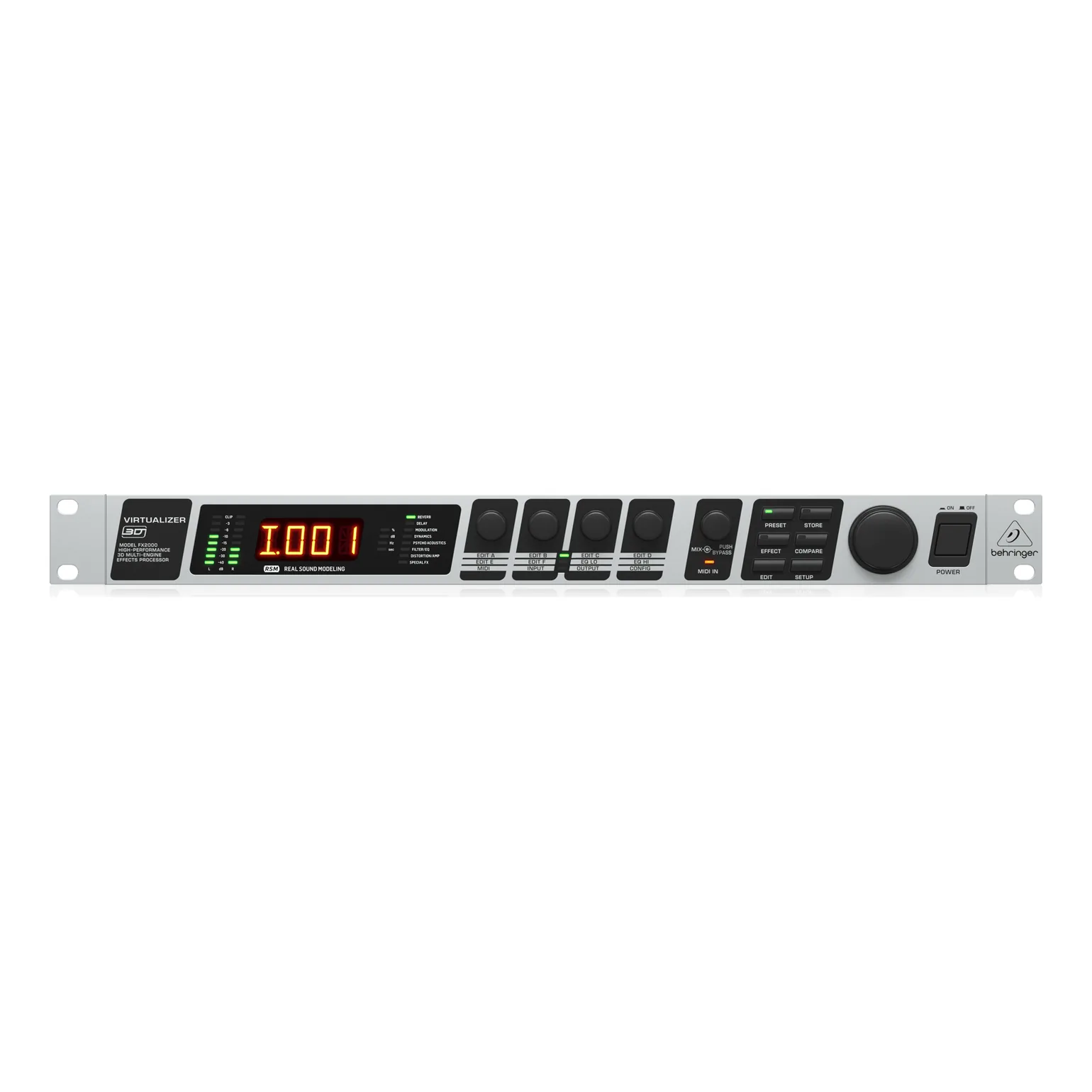
BEHRINGER VIRTUALIZER 3D FX2000 Multi-Effects Processor
- ชนิด: DSP โปรเซสเซอร์
- 71 effect algorithms: choose from 71 basic algorithms across eight algorithm groups
- factory and user presets: 100 factory presets and 100 user presets for your own settings
- Dual engine: the 24-bit processor's two engine sections process audio independently; combinations 61 to 71 run in serial 1, serial 2 or parallel
- True stereo processing: many effects process both channels separately; effects 13 to 15 and 38 allow separate left and right parameter editing
🧾 ราคานี้เป็นราคากำหนดขายจากผู้ผลิต รวมภาษีมูลค่าเพิ่มแล้ว — ไม่มีการบวก VAT เพิ่มอีก
ราคาประเมินอุปกรณ์ ไม่รวมค่าติดตั้ง · ⚠️ กรุณารอยืนยันสต็อกสินค้าก่อนสั่งซื้อ
A big room on the snare, the toms left dry.
You have miked the kit through your console, and each drum wants its own space. Patch the FX2000 into a post-fader aux, then use each channel's aux control to set how much reverb it gets.
Two engines in one rack space
The 24-bit processor runs two engines that process audio independently. Combination presets join two effects, such as chorus and reverb, in series or in parallel. Pick from 71 effect algorithms, from plate reverb to rotary speaker, and store your own programs in 100 presets.
Guitar tone without the cabinet
Distortion and amplification sounds come combined with a speaker simulation, so you can record guitar even without a speaker cabinet. In an amplifier's serial effects loop, Mix Internal mode lets you set how much effect you hear.
Change sounds while you play
Connect a MIDI foot controller to the MIDI IN socket and switch presets on stage. If it sends controller data, add chorus and delay for a solo, then remove them for a dry rhythm sound. A SysEx dump sends its complete storage content, including all settings, to a MIDI sequencer.
Features
- 71 effect algorithms: choose from 71 basic algorithms across eight algorithm groups
- factory and user presets: 100 factory presets and 100 user presets for your own settings
- Dual engine: the 24-bit processor's two engine sections process audio independently; combinations 61 to 71 run in serial 1, serial 2 or parallel
- True stereo processing: many effects process both channels separately; effects 13 to 15 and 38 allow separate left and right parameter editing
- Reverb programmes: 12 reverb programmes include Cathedral, Gold Plate, Small Hall, Room, Studio, Concert, Stage, Spring Reverb, Ambience and Early Reflections
- Delay algorithms: includes Stereo Delay, Tape Echo with filtered repetitions, and Ping Pong with changing stereo position and adjustable intervals
- Modulation effects: flanger, chorus, phaser, pitch shifter, tremolo and rotary speaker simulation
- Amp and speaker sounds: distortion and amplification sounds combined with speaker simulation
- Editable effect parameters: each preset has at least four editable parameters and up to seven, with EQ LO and EQ HI controls
- MIX/BYPASS: press the control to bypass effects and compare the original and effected signals
- Aux bus setup: with a post fader aux bus, adjust reverberation independently per channel, for example more on a snare than toms
- Serial guitar loop mode: use Mix Internal with a serial effects loop, then the MIX/BYPASS control sets effect intensity
- Parallel guitar loop mode: use Mix External with a parallel effects loop, for 100% effect at the outputs
- MIDI foot control: change presets from a MIDI foot controller, or change parameters while playing if the controller sends MIDI controller data
- MIDI connections: 5-pin DIN MIDI IN, OUT and THRU, with incoming control commands passed to other devices through MIDI THRU
- SysEx storage dump: dumps the complete storage content, including all settings, to a MIDI sequencer, and receives it back in DR.EN mode
- Balanced analogue I/O: XLR and 1/4" TRS servo-balanced inputs and outputs, selectable -10 dBV or +4 dBu operating level
- 20 Hz to 20 kHz bandwidth: ±3 dB bandwidth, 91 dB unweighted SNR (20 Hz to 20 kHz) and 0.018% typical THD at +4 dBu, 1 kHz
- 24-bit conversion: 24-bit Sigma-Delta converters with 64/128-times oversampling
- One rack unit: fits one standard 19" rack unit and needs 4" extra rear installation depth
| Analog input connectors | XLR and ¼" TRS |
|---|---|
| Analog input type | RF filtered, servo-balanced input stage |
| Analog input impedance | 80 kΩ balanced |
| Nominal operating level | -10 dBV or +4 dBu (selectable) |
| Analog max. input level | +15 dBu at +4 dBu nominal level, +1 dBV at -10 dBV nominal level |
| Analog output connectors | XLR and ¼" TRS |
| Analog output type | Electronically servo-balanced output stage |
| Analog output impedance | 80 Ω balanced |
| Analog max. output level | +15 dBu at +4 dBu nominal level, +1 dBV at -10 dBV nominal level |
| Bandwidth | 20 Hz to 20 kHz, +/- 3 dB |
| Signal-to-noise ratio | 91 dB, unweighted, 20 Hz to 20 kHz |
| THD | 0.018% typ. @ +4 dBu, 1 kHz, 0 dBu input, gain 1 |
| Crosstalk | < -76 dB |
| Converters | 24-bit Sigma-Delta, 64/128-times oversampling |
| Sampling rate | 46.875 kHz |
| MIDI interface type | 5-pin DIN-socket IN / OUT / THRU |
| Mains voltage, USA/Canada | 120 V~, 60 Hz |
| Mains voltage, Europe/U.K./Australia | 230 V~, 50 Hz |
| Mains voltage, Japan | 100 V~, 50 to 60 Hz |
| Mains voltage, general export model | 120/230 V~, 50 to 60 Hz |
| Fuse | 100 to 120 V~: T 200 mA H 250 V 200 to 240 V~: T 100 mA L 250 V |
| Power consumption | 15 Watts max. |
| Mains connection | Standard IEC receptacle |
| Ref. Code | TCR-QXQJLI |
อุปกรณ์ที่ใช้งานร่วมกัน
เพิ่มความสมบูรณ์ให้ระบบ — กด “เพิ่มลงใบเสนอราคา” ได้ทันที