



 คลิกเพื่อขยาย
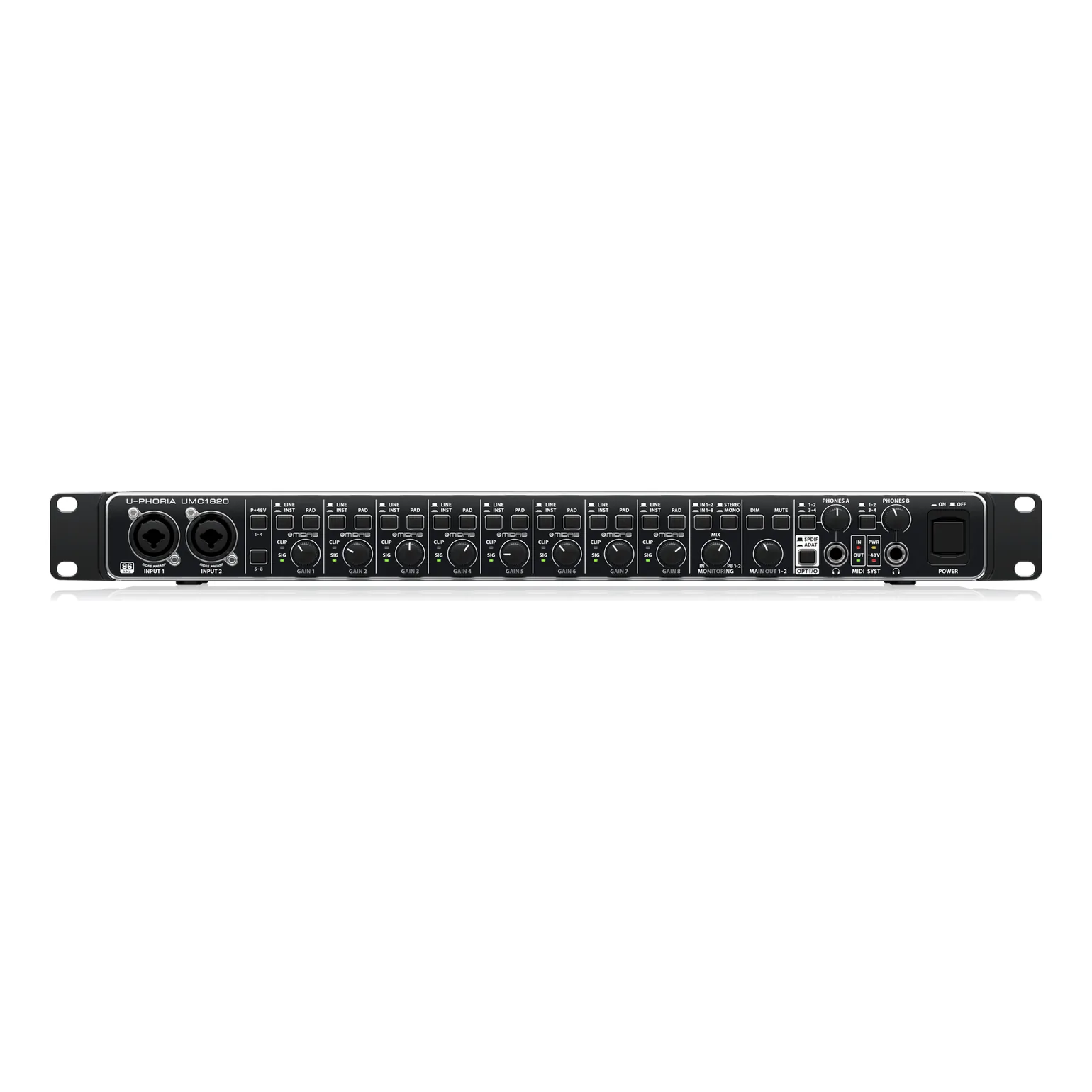
BEHRINGER U-PHORIA UMC1820 Audio Interface
- ชนิด: Audio Interface / Dante
- 18x20 USB audio and MIDI interface: 18 inputs and 20 outputs with MIDI over one USB 2.0 connection
- Eight Midas-designed mic preamps: eight combination XLR/¼" inputs, two front and six rear, each with a Midas-designed preamp
- Phantom power in two banks: switchable +48 V phantom power for inputs 1 to 4 and 5 to 8
- Pad on every input: eight pad switches reduce the level of loud sources
🧾 ราคานี้เป็นราคากำหนดขายจากผู้ผลิต รวมภาษีมูลค่าเพิ่มแล้ว — ไม่มีการบวก VAT เพิ่มอีก
ราคาประเมินอุปกรณ์ ไม่รวมค่าติดตั้ง · ⚠️ กรุณารอยืนยันสต็อกสินค้าก่อนสั่งซื้อ
Record the whole band the way it really plays.
Some bands only sound like themselves when they play in the same room. The UMC1820 lets you record that energy live, every microphone on its own track, and decide the mix later.
The whole band in one take.
Eight combination XLR/¼" inputs, two on the front and six on the rear, each feed a Midas-designed preamp. Switch phantom power for inputs 1 to 4 and 5 to 8, tame a loud kick with the pad on every input, and plug a guitar straight in with the line/instrument selector. Conversion is 24-bit at up to 96 kHz.
When eight is not enough.
At 44.1 or 48 kHz, the optical ADAT input adds eight channels from an optional external preamp, and coaxial S/PDIF adds two digital channels: up to 18 inputs in all.
Two pairs of headphones, two different mixes.
Blend your live inputs with computer playback, and hear those inputs at 0 ms latency. Each headphone output listens to the monitor mix or to playback channels 3 and 4, so the singer in the booth and you at the desk each hear what you need. Eight line outputs feed more monitoring, and 5-pin MIDI connects keyboards and modules.
Features
- 18x20 USB audio and MIDI interface: 18 inputs and 20 outputs with MIDI over one USB 2.0 connection
- Eight Midas-designed mic preamps: eight combination XLR/¼" inputs, two front and six rear, each with a Midas-designed preamp
- Phantom power in two banks: switchable +48 V phantom power for inputs 1 to 4 and 5 to 8
- Pad on every input: eight pad switches reduce the level of loud sources
- Line or instrument level: a line/instrument selector lets you plug a guitar straight into the ¼" connector
- 24-bit at up to 96 kHz: records at 44.1, 48, 88.2 or 96 kHz with 24-bit converters
- ADAT, S/MUX and S/PDIF optical I/O: optical ports run ADAT at 44.1/48 kHz or S/MUX at 88.2/96 kHz, or S/PDIF, for digital expansion
- Coaxial S/PDIF in and out: RCA coaxial S/PDIF input and output alongside the optical ports
- MIDI in and out: 5-pin DIN MIDI input and output for keyboards, controllers and modules
- Zero-latency direct monitoring: monitor analogue inputs 1-2 or all eight at 0 ms latency while recording
- Input and playback mix: the monitoring knob blends direct inputs with computer playback; stereo/mono sets the image
- Two headphone outputs: two ¼" TRS headphone outputs switch between the monitor mix and playback channels 3-4
- Main outputs with dim and mute: balanced ¼" TRS main outputs with a main out level knob and dim and mute switches
- Eight line outputs: balanced ¼" TRS line outputs 3 to 10 for additional monitoring and recording
- No driver needed on a Mac: runs without a driver on Mac OS 10.9 or higher; the Windows driver is a download from behringer.com
- Metal chassis: housed in an impact-resistant metal chassis
| Preamps | 8 x Midas-designed |
|---|---|
| Input type | XLR / TRS combo connector (Mic/Line/Instrument), 2 front / 6 rear |
| Input level attenuation | 8 x pad switch |
| Input frequency response | 10 Hz to 85 kHz (+0/-3 dB) / direct monitor |
| Input impedance | Mic in: 3 kΩ / Instrument in: 1 MΩ |
| Max. input level | Mic: 11 dBu / Line: 11 dBu / Instrument: 18 dBu |
| Phantom power | +48 V switchable inputs 1-4 and 5-8 |
| Output type | 8 x ¼" TRS, line outputs; 2 x ¼" TRS, main outputs; 2 x ¼" TRS stereo, headphone outputs |
| Output frequency response | 10 Hz to 85 kHz (+0/-3 dB) / direct monitor |
| Max. output level | +16 dBu line outputs; +16 dBu main outputs; +21.5 dBu headphone outputs |
| System frequency response | 10 Hz to 40 kHz (+0/-3 dB) @ 96 kHz sampling rate |
| System dynamic range | 106 dB, A-weighted |
| Converter resolution | 24-bit |
| Supported sample rates | 44.1, 48, 88.2, 96 kHz |
| Digital audio I/O type | Coaxial: RCA, 1 In, 1 Out; Optical: TOSLINK, 1 In, 1 Out |
| MIDI I/O type | 5-pin DIN, 1 in / 1 out |
| Computer connection type | USB 2.0, type B |
| Digital audio I/O supported formats | ADAT, S/PDIF, S/MUX |
| S/PDIF selected (OPT I/O switch out) | RCA In = off; Optical In = S/PDIF (ch. 9-10); RCA Out + Optical Out = S/PDIF (ch. 11-12) |
| ADAT selected (OPT I/O switch in) | RCA In = S/PDIF (ch. 9-10); Optical In @ 96 / 88.2 kHz = S/MUX (ch. 11-14); Optical In @ 48 / 44.1 kHz = ADAT (ch. 11-18); RCA Out = S/PDIF (ch. 11-12); Optical Out @ 96 / 88.2 kHz = S/MUX (ch. 13-16); Optical Out @ 48 / 44.1 kHz = ADAT (ch. 13-20) |
| Operating systems | Fully compatible with Windows XP or higher; Fully compatible with Mac OS 10.9 (Mavericks) or higher; For older OS X versions, the following restrictions apply:; 10.8 (Mountain Lion) + 10.7 (Lion):; After changing the “OPT I/O” mode with the front panel switch, you must; refresh the OS X Audio-Midi-S |
| Drivers | Mac: No driver required (CoreAudio/CoreMIDI compliant); Windows: Drivers for Windows XP and above are available.; Download the correct driver for your system from behringer.com |
| Direct monitor control | Mix control (inputs/playback 1-2); Source select (analogue inputs 1-2/1-8); Stereo/Mono select |
| Main L/R control | Output Level 1/L to 2/R control, dim and mute switch |
| Headphones DJ cueing | Monitor switches (monitor mix 1-2 / playback out 3-4) |
| Power supply voltage | 12 V DC (from supplied AC/DC adapter) |
| Power consumption | 20 W |
| Ref. Code | TCR-WCE745 |
คู่มือ (Manual)
อุปกรณ์ที่ใช้งานร่วมกัน
เพิ่มความสมบูรณ์ให้ระบบ — กด “เพิ่มลงใบเสนอราคา” ได้ทันที