








 คลิกเพื่อขยาย
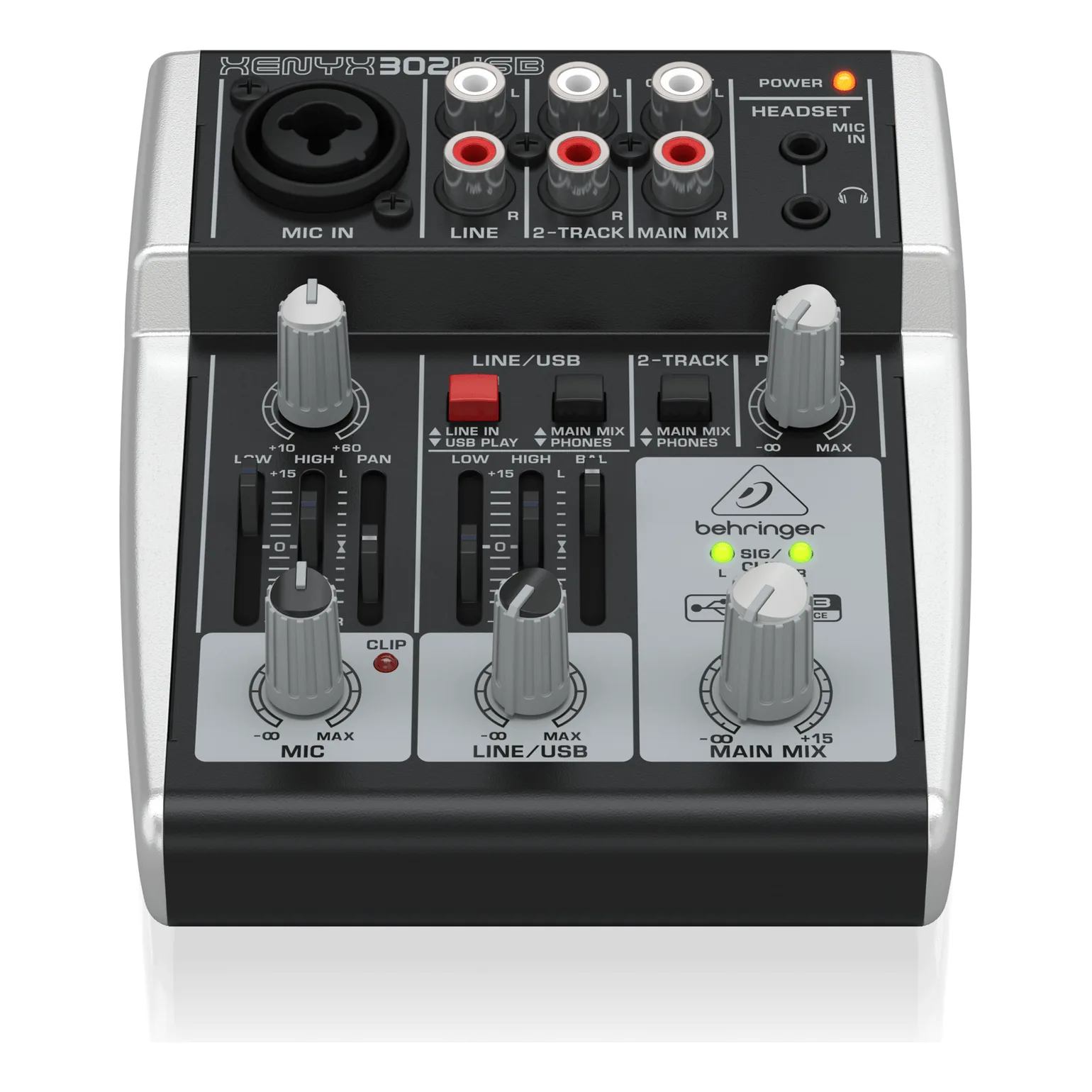
BEHRINGER XENYX 302USB Analog Mixer
- ชนิด: มิกเซอร์อนาล็อก
- Mic input: XLR/¼" combo connector, electronically balanced, with a gain range of +15 dB to +55 dB
- Headset mic input: HEADSET MIC IN on a ⅛" TRS mini jack; do not use it at the same time as the MIC IN jack
- Mic preamp noise: E.I.N. of -130 dB (-133.1 dB A-weighted) at 0 Ω source resistance, measured 20 Hz to 20 kHz
- GAIN and CLIP: GAIN sets the sensitivity of MIC IN and HEADSET MIC IN, and the CLIP LED lights when that source overloads
🧾 ราคานี้เป็นราคากำหนดขายจากผู้ผลิต รวมภาษีมูลค่าเพิ่มแล้ว — ไม่มีการบวก VAT เพิ่มอีก
ราคาประเมินอุปกรณ์ ไม่รวมค่าติดตั้ง · ⚠️ กรุณารอยืนยันสต็อกสินค้าก่อนสั่งซื้อ
A small desk between your voice and the laptop.
Your show needs a clear voice, a little music and a way into the computer. The 302USB is a 0.38 kg mixer with a USB audio interface inside. Set it beside the laptop and start talking.
A mic or a headset, your choice
A studio microphone goes into the XLR/¼" combo input and its XENYX preamp. Prefer a headset? Use HEADSET MIC IN instead, but never both jacks at once. With a headset such as the HS1000, connect both of its cables to avoid unwanted noise. Two EQ sliders adjust the low and high frequencies.
Music from the laptop or a player
The LINE/USB channel plays either the RCA line input or audio returning from your computer. The 2-TRACK RCA inputs take a further stereo source. For karaoke, a DVD player or computer supplies the music while you sing.
Playback in your ears, not in the recording
Routing buttons send the LINE/USB channel and the 2-track inputs to PHONES or MAIN MIX. While recording, route USB PLAY to PHONES: you hear the computer, and it stays out of the main mix. USB audio runs at 16-bit, 48 kHz. Power comes from the included USB power adaptor or from the computer, though some tablets may not supply enough.
Features
- Mic input: XLR/¼" combo connector, electronically balanced, with a gain range of +15 dB to +55 dB
- Headset mic input: HEADSET MIC IN on a ⅛" TRS mini jack; do not use it at the same time as the MIC IN jack
- Mic preamp noise: E.I.N. of -130 dB (-133.1 dB A-weighted) at 0 Ω source resistance, measured 20 Hz to 20 kHz
- GAIN and CLIP: GAIN sets the sensitivity of MIC IN and HEADSET MIC IN, and the CLIP LED lights when that source overloads
- Two-band EQ: EQ sliders adjust the low band at 80 Hz and the high band at 12 kHz, each by ±15 dB
- PAN/BAL slider: positions the channel in the stereo field
- LINE/USB channel: LINE/USB FROM chooses LINE IN or USB PLAY, and the LINE/USB knob sets its volume
- Output routing: LINE/USB TO routes the LINE/USB channel to PHONES or MAIN MIX; 2-TRACK TO routes the 2-TRACK inputs to PHONES
- Stereo inputs: stereo line input and 2-track input, both on unbalanced RCA jacks
- Outputs: main outputs on unbalanced RCA and a ⅛" TRS mini jack phones output, set with the PHONES knob
- SIG/CLIP metering: LEDs light green when a signal appears in the main bus and red when the signal begins to overload
- USB audio: 16-bit converter at a 48 kHz sample rate on a USB Type B connector
- Windows driver: the free ASIO4ALL driver is an alternative
- USB power: runs from the included USB power adaptor or from a computer via bus power; some tablets may not provide sufficient bus power
- Compact size: 46 x 114 x 136 mm (H x W x D) and 0.38 kg
| Mic input type | XLR / ¼" combo connector, electronically balanced |
|---|---|
| Mic E.I.N. @ 0 Ω source resistance | -130 dB / -133.1 dB A-weighted (20 Hz - 20 kHz) |
| Mic E.I.N. @ 50 Ω source resistance | -128 dB / -131.5 dB A-weighted (20 Hz - 20 kHz) |
| Mic E.I.N. @ 150 Ω source resistance | -127 dB / -129.8 dB A-weighted (20 Hz - 20 kHz) |
| Mic frequency response (-1 dB) | 18 Hz to 40 kHz |
| Mic frequency response (-3 dB) | < 10 Hz to 75 kHz |
| Mic gain range | +15 dB to +55 dB |
| Mic max. input level | +12 dBu @ +10 dB Gain |
| Mic input impedance | 2 kΩ |
| Mic signal-to-noise ratio | 98 dB / 101 dB A-weighted (0 dBu in @ +22 dB Gain) |
| Mic distortion (THD+N) | 0.013% |
| Stereo line input type | RCA jacks, unbalanced |
| Stereo line input impedance | 6 kΩ |
| Stereo line input gain range | -∞ to +20 dB |
| Stereo line input max. input level | +20 dBu |
| 2-track input type | RCA jacks, unbalanced |
| 2-track input impedance | 20 kΩ |
| 2-track max. input level | +20 dBu |
| Headset mic input type | ¹⁄₈" TRS mini jack |
| Headset mic input impedance | 6 kΩ |
| Headset mic max. input level | +22 dBu @ Gain Min |
| Main outputs type | RCA, unbalanced |
| Main outputs impedance | 470 Ω |
| Main outputs max. output level | +22 dBu |
| Phones output type | ¹⁄₈" TRS mini jack |
| Phones output max. output level | +7 dBu / 150 Ω |
| Noise, main mix @ -∞, channel fader @ -∞ | -96 dBu / -101 dBu A-weighted |
| Noise, main mix @ 0 dB, channel fader @ -∞ | -82 dBu / -87 dBu A-weighted |
| Noise, main mix @ 0 dB, channel fader @ 0 dB | -80 dBu / -85 dBu A-weighted |
| EQ low | 80 Hz / ±15 dB |
| EQ high | 12 kHz / ±15 dB |
| USB connector | Type B |
| USB converter | 16-bit |
| USB sample rate | 48 kHz |
| External USB switching power supply, input voltage | 100 to 240 V~, 50/60 Hz |
| External USB switching power supply, power consumption | 3.6 W |
| 302USB input voltage | 5 V DC, 500 mA |
| 302USB power consumption | 0.9 W |
| Ref. Code | TCR-VQXTCR |
คู่มือ (Manual)
อุปกรณ์ที่ใช้งานร่วมกัน
เพิ่มความสมบูรณ์ให้ระบบ — กด “เพิ่มลงใบเสนอราคา” ได้ทันที